
Porsche 924S • 1986–1988
The Fast, the Rare, and the Forgotten
The 944's engine. The 924's body. Half the price. Zero respect. For now.
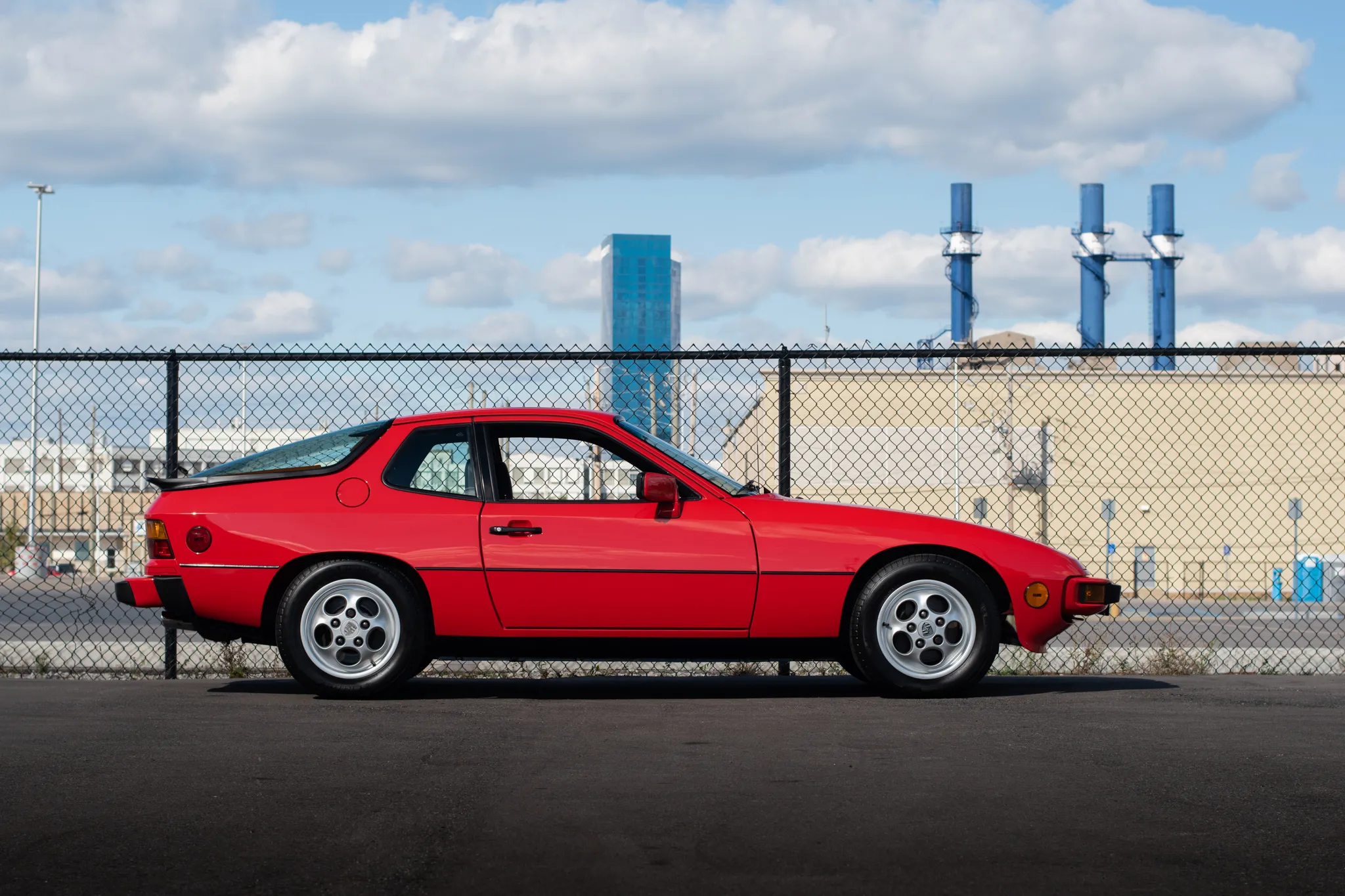
1987 Porsche 924S in Guards Red. Telephone-dial wheels. That wedge profile. The car that got away — and hasn't gotten away yet.
Here is a Porsche built for three years, sold for under $20,000 new, then quietly shelved while the world moved on. It weighs 200 lbs less than a 944. It shares the 944's engine, brakes, and suspension. In 1988 it was actually faster than the base 944 — Porsche's own engineers admitted it. Clean examples still trade under $25,000.
The 924S is the car that got away. It just hasn't gotten away yet.
The Pattern
This Story Has Happened Before
You know the Porsche 914? Mid-engine, targa top, joint VW-Porsche project, launched 1969? Critics called it "the VW-Porsche." Purists sneered. Values sat in the gutter for decades. Today a clean 2.0L 914 trades at $20,000–$25,000, the six-cylinder 914/6 fetches six figures, and everyone who bought one for $4,000 in 2005 looks like a genius.
The 924S is that car. Right now. At that exact moment.
Same pattern: dismissed as not a "real Porsche," years of neglect keeping values low, enthusiast community quietly discovering what the market missed. Except unlike the 914, the 924S got a proper Porsche engine before it died — which makes the coming reappraisal potentially sharper.
The Backstory
The Audi Engine Nobody
Wants to Admit
The original 924 (1976–1985) had excellent handling and a clean design but came with an inconvenient origin story. Its 2.0-litre four-cylinder was Audi-sourced — specifically taken from the Audi 100 sedan (VW Group designation EA831). Porsche's own website is unambiguous: "The 125-PS engine was taken from the Audi 100 and modified accordingly by Porsche." The story that it came from a VW LT van is a myth — it appeared in the Audi 100 first. But the sneer stuck regardless.
Then in 1984, Volkswagen pulled the plug on producing those engine blocks entirely. Porsche was left without a powerplant for its cheapest car. The solution was inspired: transplant the Porsche-built 2.5-litre four from the 944 into the 924 body, add 944-spec vented disc brakes all round (replacing the rear drums), fit five-lug wheels, upgrade the suspension, and price it under $20,000 in the US. Call it the 924S.
For the first time, the 924 had an engine Porsche could be proud of. It arrived just in time to be discontinued.
Model History
Three Years. Three Chapters.
One Window.
1986 — Europe Only. The 924S debuts at 150 PS, top speed 134 mph. The distinctive "telephone dial" five-hole alloys immediately set it apart from any standard 924. Buyers lap it up.
1987 — America Gets It Back. The 924S returns to the US at $19,905 base, 147 hp SAE, 9.5:1 compression (US emissions equipment takes its toll), 0–60 in 8.3 seconds. No fender flares. Pop-up headlights. Manual everything. Also in 1987: the 924S Le Mans — 980 cars worldwide, built to honour Porsche's 12th overall Le Mans win. Two colours: black (813 cars, the only US option) and Alpine White (167 cars for other markets only). The white ones are the scarce ones.
1988 — The Best One. New pistons raise compression to 10.2:1 across all markets. Every car now makes 160 bhp / 158 hp SAE. The 1988 924S was measurably lighter and more aerodynamic than the 944 — faster through the air than its more expensive sibling. Three-point rear seatbelts arrive. This car got better just in time to be axed.

The telephone-dial wheel. Five holes, Porsche crest, and the only identifier you need to spot a 924S from across a car park.
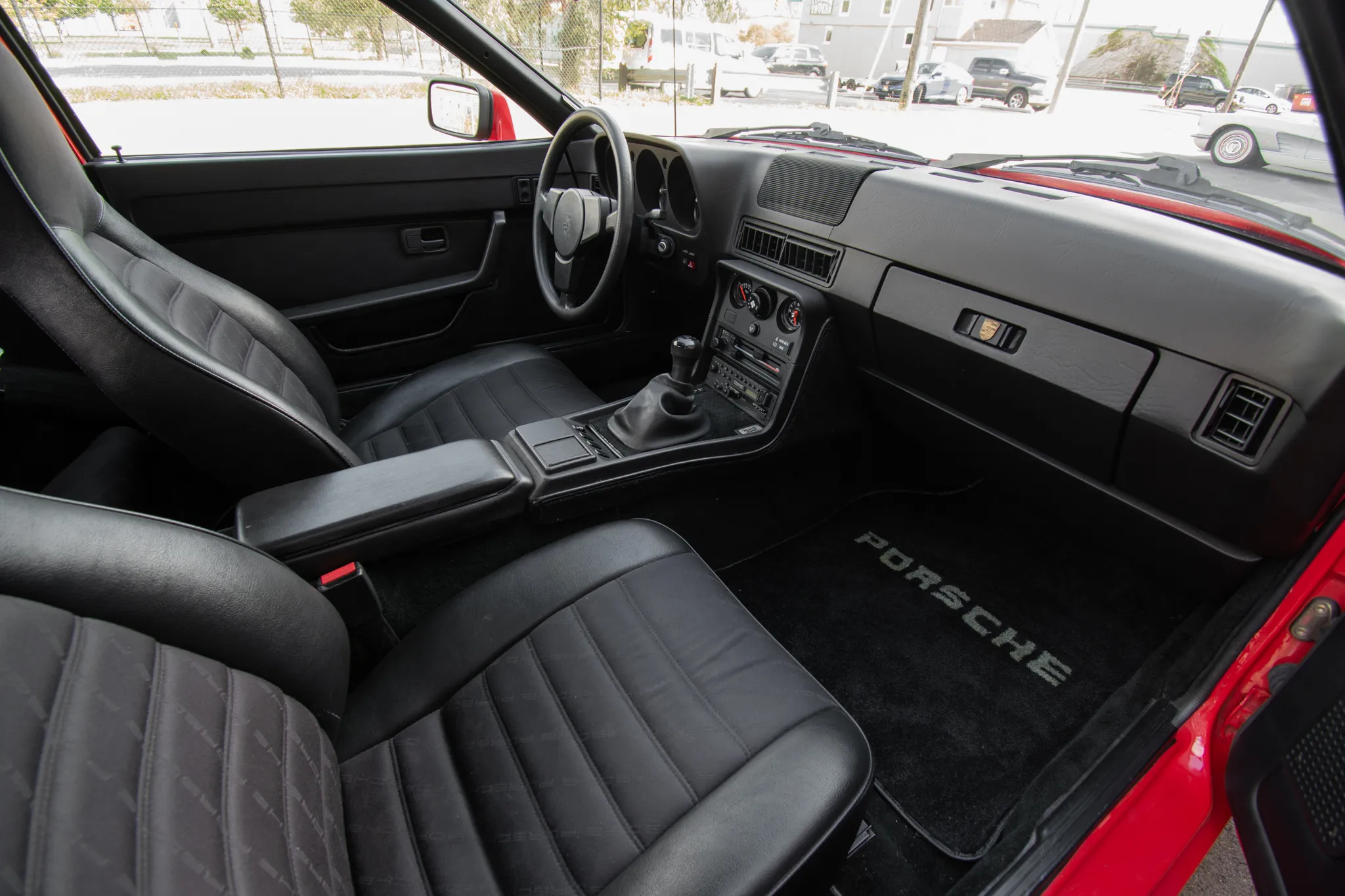
Simple. Purposeful. That five-speed sits exactly where your left hand falls. The PORSCHE mat is factory — and it still looks right.
The Rarest Variant
980 Cars. One Purpose.
Strip Everything.
The 1988 Special Edition — M756 in the US, M755 "Le Mans" in the UK, "Exclusiv" in Germany, "Spirit" in Spain, "Club Sport" in Japan — was built for Showroom Stock racing. Many of them actually raced.
Porsche's recipe: delete the air conditioning, radio, sunroof, cruise control, power windows, and passenger door mirror. Add Koni adjustable sport shocks, stiffer torsion bars and anti-roll bars, a 10mm lower ride height, and wider 15×7 rear wheels.
"Porsche deleted the passenger door mirror. From a $23,000 sports car. Because it weighed something."
Behind the Wheel
What It Feels Like
You drop into a very low seat. The cabin is simple. No screens, no drama. Unassisted rack-and-pinion steering — you feel everything. The five-speed transaxle throws with quiet precision. Third gear is, as Motor Sport Magazine put it in 1986, "a lovely urgent gear to be in on an interesting road."
The 2.5-litre needs revving. Below 3,000 rpm it's polite. Above 4,000 it's alive. You will not win a traffic light drag. You will win every corner. The transaxle layout — engine front, gearbox rear, connected by a rigid torque tube — puts weight distribution at 48/52 front to rear. The result is neutral, predictable, deeply satisfying handling. One modern tester: "It handles like it's on rails. Puts a smile on your face when exiting a corner on a back-road."
Build Culture
The 924S That Went to
Baja to Play Golf
Here is a 924S origin story that the platform deserves. A man in Vancouver, Washington bought a 1987 924S for one reason: the golf tournament he wanted to enter required players to be Porsche owners. He found the cheapest running Porsche on Craigslist — $2,500 — played his round, and moved on. The car sat.
Two builders from Portland, Chris Harrell and Michael Prstojevich, found the ad. They had signed up for the Baja XL Rally — nearly 5,000 km of mainly off-road routes through Baja California — and needed a car. They wanted a 944 but couldn't find the right one. The 924S was cleaner than anything they'd seen, had some light guardrail rash on the passenger side, and cost considerably less than their budget. They negotiated. They bought it.
The 924S's near-perfect 48/52 front-rear weight distribution was the deciding factor. The naturally-aspirated 2.5-litre four-cylinder would run happily on sketchy Mexican fuel. The hatchback would carry everything they'd need. The platform was, as they put it, "remarkably ahead of its time."
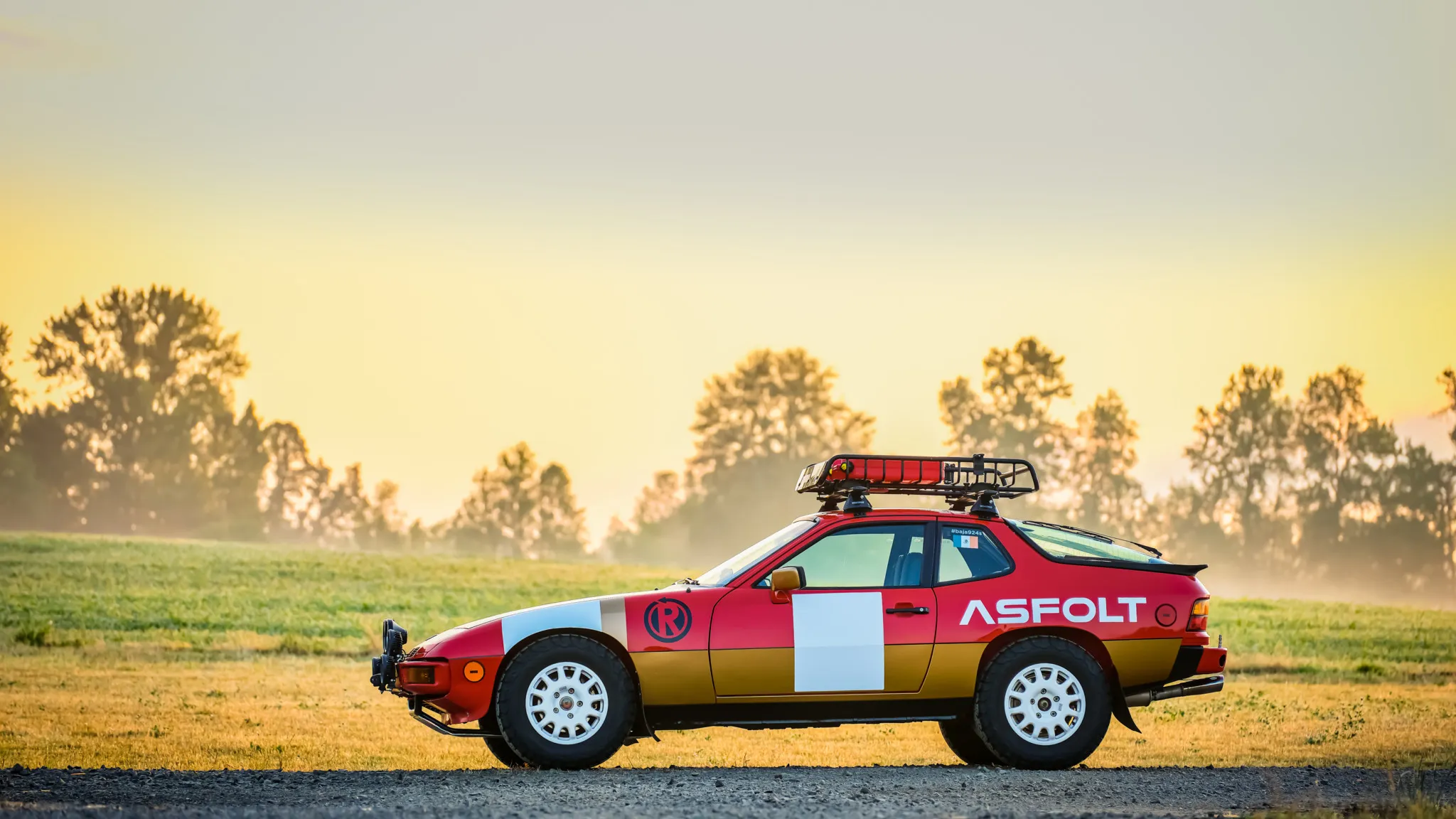
The #BAJA924S — Guards Red with Asfolt rally livery, Yakima roof rack, Warn winch, six rally lights, BFGoodrich KO2s, and a limited-slip diff. Built in Portland for the Baja XL Rally. Photo: Petrolicious / Patrick Stevenson
Working with Avant Garde in Portland, they built the car on a genuine budget — the goal was to prove that a 924S Safari build could be just as cool as a Safari 911, for significantly less capital. The build swapped in a 924 Turbo (931) hood and nose for the cleaner look, fitted a Yakima roof rack (installed at Yakima's own HQ at their cost), added a Warn winch, six rally lights, BFGoodrich KO2 tires on Braid wheels, a limited-slip differential, custom skid plates, and a Garmin GPS with CB radio. The livery was briefed by the team and created by Avedis Djinguelian, with partnership from Asfolt (bespoke Porsche interior specialists) and RetroGrade Motoring.
They drove it from Portland to Baja. They raced 5,000 km. They drove it home. The platform didn't protest.
The Community
Who's Doing This
The 924S community doesn't look like you'd expect. That's the point.
Lara Newton — @thatporschegirl (141K Instagram followers) is a Hollywood precision driver who has doubled for Julia Roberts and Jennifer Connelly and is arguably the most influential woman in the Porsche classic space. Porsche's own Christophorus magazine quoted her directly: "I'd like to see women at the wheel and on the registration documents." She answers technical questions, helps younger women find their first Porsche, and is actively reshaping who this community looks like.
Search #porsche924s or #porschetransaxle on Instagram. Young men and women, European, American, Japanese — stock, modified, or on dirt — all connected by the same discovery: the 924S was worth more than people thought.
Market Timing
The Youngtimer Window Is Open.
Not for Long.
A Youngtimer is a car between 20 and 30 years old — too recent to be an official classic, but already pulling enthusiast attention. The 924S crossed the 30-year Oldtimer threshold between 2016 and 2018, now qualifying for Germany's H-plate historic vehicle status — the crossing point where values historically begin their real move.
Base 944s that were $8,000 in 2015 are $15,000–$22,000 today. 944 Turbos that were $25,000 are pushing $50,000. The appreciation is moving through the transaxle family, model by model. The highest recorded auction result for a 924S — $39,000 at Bring a Trailer in February 2020 (Lot #28,047, an 8,000-mile 1988 example) — was a proof of concept, not a ceiling.
The 914 took 20 years to be properly discovered. The 924S is being discovered now, with Instagram accelerating every trend that used to take a decade.
Buyer's Guide
What to Buy.
What to Watch For.
The Sweet Spot
Any 1988 manual 924S with documented service history. 160 hp, lighter than a 944, and excellent parts availability through the shared 944 supply chain.
The Holy Grail
1988 Special Edition (M756 US). Black only. Stripped for racing. Koni-suspended. Wider rear wheels. One of 500 US cars, 980 worldwide. Buy it if you find it.
The Hidden Gem
1987 Le Mans in Alpine White. Only 167 white examples were made worldwide. The black cars filled US showrooms — white is the genuinely scarce colour.
Parts Reality
Better than you think. The 924S shares its entire drivetrain with the far more common 944. 944online.com (Pompano Beach, FL) carries a large inventory of new parts with a dedicated 924S 86–88 section — including hard-to-find items and re-plated originals. For quality used parts, Elliott Grafton of @944barn in Blairsville, GA is your next call — one of the most comprehensive inventories of used 944/924S parts in the US, sourced from cars he dismantles himself. If Elliott doesn't have it, it probably isn't available. Both are official sponsors of 944Fest.
Mark Your Calendar
944Fest 2026
The World's Largest Gathering of Porsche 944s
September 4–6, 2026 · Virginia International Raceway, Alton, VA · 25th anniversary. HPDE track sessions, road rally, car show, off-road course, awards dinner — all transaxle cars welcome (924, 944, 968, 928). Elliott Grafton's 944barn and 944online are both official sponsors. If you're buying a 924S, this is where the community lives.
Non-negotiables before buying:
- Timing belt history. The 2.5L is a confirmed interference engine — belt failure means bent valves, guaranteed. The preventive service (belt, tensioner, rollers, water pump) runs $1,500–$1,800 at a specialist shop, every 30,000 miles or 3–5 years. A DIY head repair after failure runs $800–$1,200 in parts alone before labour. The sneakier failure mode: an aged tensioner roller shedding its teeth and killing belt tension. Replace the rollers every single time.
- Battery tray rust. Poke it. Corroded tray drips water onto the fuse box. The classic 924-family ambush.
- DME relay condition. Cheap to replace, known failure point. Carry a spare.
- Bosch airflow meter. Can be reconditioned, but confirm it's working before you commit.
- Sills and rear subframe mounts. Salt-belt cars are higher risk. Probe carefully.
Specifications