
The Three-Way That Matters
Old Dog, New Tricks,
No Apologies
A 1962 Jaguar MkII 3.8 Manual rolls into a decade it was never invited to — and proceeds to embarrass everyone in the car park.
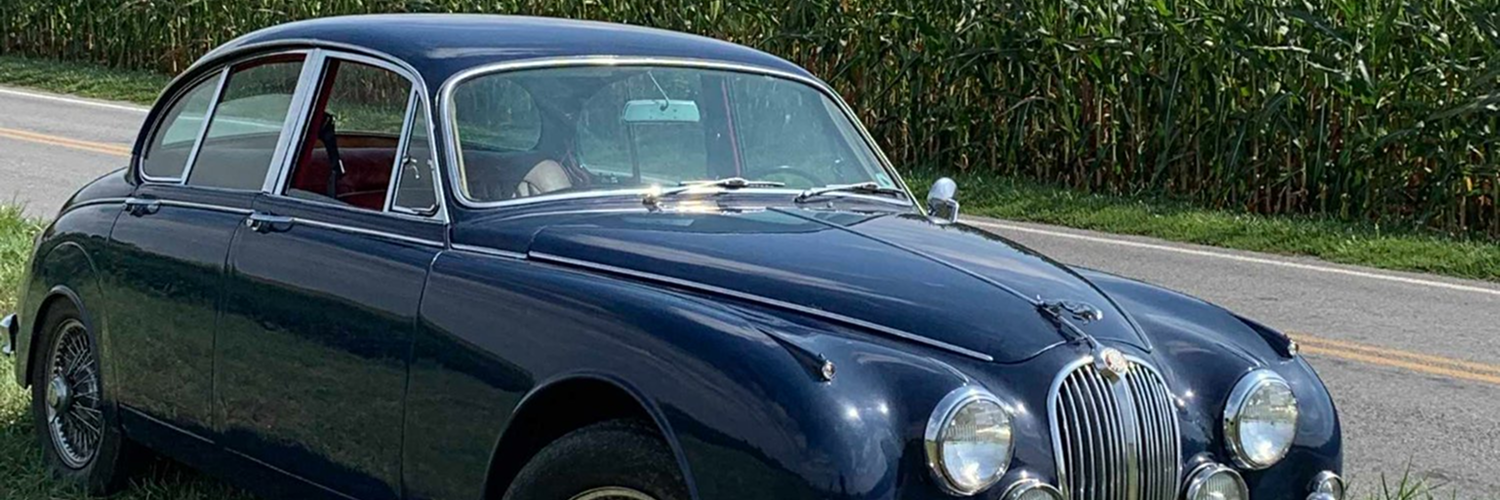
The 1962 Jaguar MkII 3.8 Manual. Deep Indigo Blue. Wire wheels. A posture that does not ask for your approval.
There is a particular breed of automotive confidence that belongs only to those who show up to the party a decade late, dressed better than everyone else, and make a point of helping themselves to the best Scotch before anyone thinks to object. The 1962 Jaguar MkII 3.8 — manual gearbox, wire wheels, and the faint ghost of a Mayfair solicitor's aftershave baked into the leather — is exactly that man. The year is 1972. The invitation was never extended. The Jaguar doesn't care.
On paper, the premise is absurd. A ten-year-old British saloon walking into a showroom contest against BMW's freshly minted Bavaria and Mercedes-Benz's plutocratic 280SE 4.5? One might expect a polite thumping followed by a graceful retirement to the hedgerows. What one gets instead is considerably more embarrassing — for the newcomers. The Jaguar's 3.8-litre twin-cam straight-six produces 220 honest brake horsepower. The Bavaria musters 170. Do the arithmetic yourself; the Jaguar already has.
The Contestants
The BMW Bavaria arrived as the working-class cousin of the prestigious 2500/2800 series — same M30 engine family, fewer chromium fittings, a price that didn't require a second mortgage. By 1972, it had become the thinking man's sporting saloon. It handled with Teutonic precision, rewarded a driver who understood the difference between understeer and a character flaw, and projected an image of restrained intellectual competence. Think of it as the ambitious assistant professor who cycles to work and reads Habermas on the train. Admirable. Somewhat earnest.
The Mercedes-Benz 280SE 4.5 was an altogether different proposition — a 4.5-litre V8 inserted into the stately W108 body like a quietly devastating secret. Stuttgart had taken its most dignified executive saloon and installed an engine more suited to the obliteration of lesser vehicles on the autobahn. The result was a car that could achieve 127 miles per hour while looking precisely as though it was doing nothing of the sort. The automatic transmission confirmed its intentions: this was not a car for men who enjoyed working. This was a car for men who employed them.
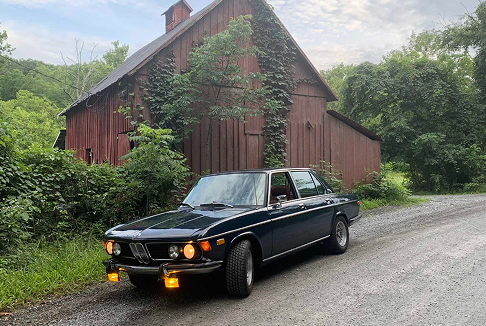
The Bavaria. Precise, earnest, admirably uncomplicated. Like a very fast doctoral candidate.
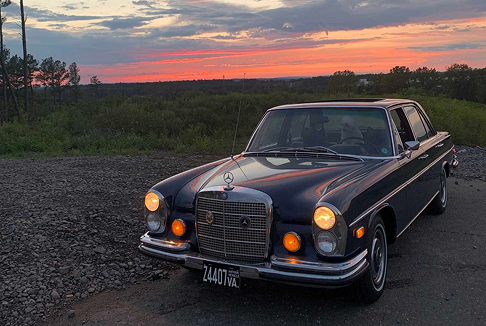
The 280SE at dusk. A diplomat arriving late to a war it will win on paperwork.
“The Jaguar's party trick was not merely that it could keep pace — it was that it could do so while looking as though keeping pace was vaguely beneath it.”
Can the Old Dog Run?
To answer whether a 1962 Jaguar can run with the 1972 crop requires first establishing what running actually means. In raw numbers, the contest is closer than anyone in Munich or Stuttgart would care to admit. The MkII 3.8 manual dispatches the 0–60 sprint in approximately 8.5 seconds — precisely matching the 280SE, despite being born in the same year John Glenn was orbiting the Earth. At the top end, the Jaguar's 125 mph maximum is a rounding error away from the Mercedes's 127. The Bavaria, for its part, doesn't quite reach 120 and has the decency to look sheepish about it.
The critical differentiator is power-to-weight ratio — what drivers call the sensation of being properly rewarded for bravery. The MkII at 1,400 kilograms is the lightest car in this test. The Mercedes tips the scales at 1,720 kilograms — a difference of 320 kilograms that, on a good B-road with a willing driver, translates to the Jaguar doing things the Mercedes is still negotiating with its torque converter about. Through corners specifically, the Jaguar communicates with its driver in a language that hasn't been filtered, translated, or made safe for consumption.
The manual gearbox — that endangered species — is of course the Jaguar's secret weapon and the Bavaria's competitive equaliser. Both cars reward a man who treats gear selection as a conscious act rather than a bureaucratic formality. The Mercedes, in its four-speed automatic, has absented itself from this conversation entirely and delegated the matter to a committee. It is smooth. It is effortless. It is, in the way that all thoroughly managed experiences are, slightly less alive.
The Modern Sleeper Legacy
What these three cars bequeathed to the modern era is the original taxonomy of the sleeper — that most dangerous category of automobile, which appears to be having a quiet evening and is in fact conducting hostile takeovers. The Jaguar MkII established the fundamental principle: that true velocity need not announce itself, that a four-door car in a dark colour with a discreet badge is the most consistently surprising object in any car park, and that the men most worth worrying about are those who see no need to explain themselves.
The Bavaria's ghost lives on in the E28 M5, the entire lineage of Bavarian sports saloons that culminated in a generation of young professionals driving quite quickly indeed while pretending they were merely going to the shops. The 280SE's V8 logic resurfaces in every S-Class AMG, every car that combines executive deportment with the performance profile of something that should not technically be able to do this. The MkII's legacy is less corporate and more personal — it lives in every XJR, in every man who bought a Jaguar saloon instead of a BMW because he understood that some experiences are not available to those who choose the sensible option.
The modern era of performance saloons — your Panamera Turbos, your AMG E63s, your M5 Competitions — is essentially an arms race conducted in the spirit these three cars accidentally initiated in 1972. Except now the horsepower figures would have seemed, to William Lyons, like a practical joke. The Jaguar started a conversation about what a four-door car was actually capable of. Half a century later, the conversation has become quite heated. The Jaguar, naturally, declines to apologise.
Final Assessment -- Three Cars, One Outcome
Final Assessment -- Three Cars, One Outcome
The Seducer's Sidebar
The Man Who Doesn't Need to Try
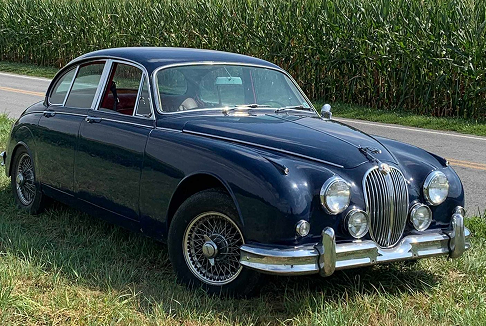
Still the best-looking thing in the room. Still aware of it.
Every debutante season produces the same drama. There he is — fifteen years their senior, not a grey hair out of place, wearing a suit that was made for him by someone who understood that fit is a form of argument. He has not adjusted his collar once. He is not trying. That is, of course, precisely the point.
“The young ones have more horsepower. He has more history. History wins every time after 10 p.m.”
The Bavaria is the bright-eyed young man with excellent prospects and a crisp shirt who has rehearsed his opening line. The 280SE is the recently promoted vice-president who arrives in a company car and talks about the Frankfurt motor show. Both are perfectly fine options, in the way that sensible shoes are perfectly fine options.
And then there is the Jaguar.
The Jaguar does not open with a line. It arrives — deep blue, wire-wheeled, the XK straight-six ticking quietly as it cools — and simply occupies the room with the unhurried authority of a man who has already been to three countries this week and enjoyed himself in all of them. The walnut fascia is not an affectation. The red leather is not a boast. They are simply what the interior of a serious car looks like, and anyone who requires an explanation has already lost the plot.
The young contenders are faster on paper, more efficient, better equipped for the modern world. They are twenty-five and full of ideas. The Jaguar is forty, has heard most of those ideas before, and has a very good story about why three of them don't work — delivered with a half-smile and a Scotch that appeared from somewhere without anyone quite noticing.
“It doesn't compete. It presides.”
By the end of the evening, the Bavaria has exchanged business cards with someone mildly interested. The Mercedes has been admired from a respectful distance. The Jaguar has left — quietly, early, and not alone. The wire wheels catch the last of the light as it rounds the corner, and the sound the exhaust makes is the sound of a man who knew exactly what he was doing the entire time and simply declined to make a fuss about it.
Some cars are driven. Some cars are appreciated. The MkII 3.8 is understood — but only by those who've stopped trying to impress anyone, which is, rather elegantly, the highest form of impression there is.
The Jaguar does not chase. It selects.